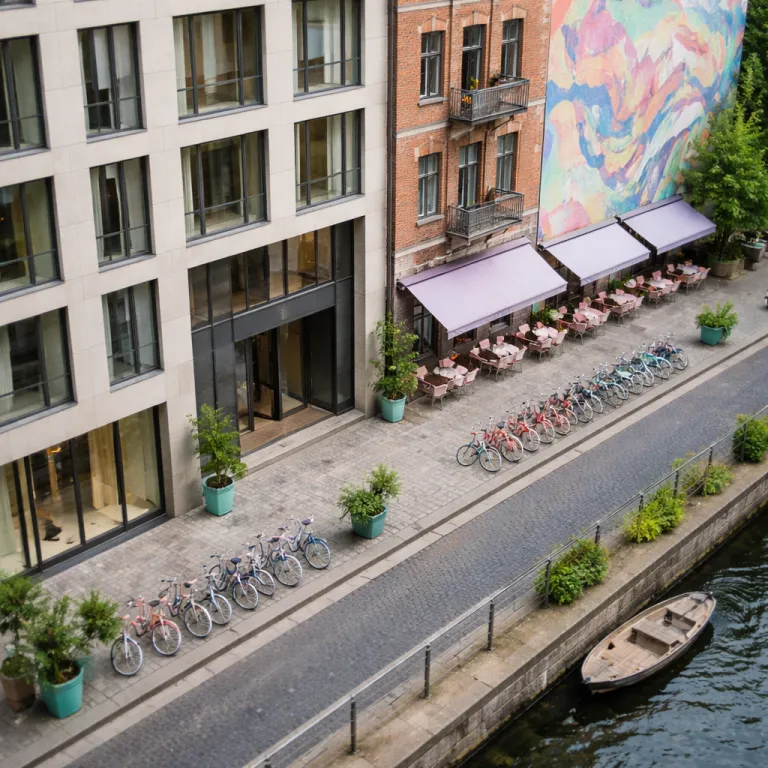
Berlin neighborhoods, luxury hotels and the new gentrification fault lines
Berlin is now a laboratory where neighborhood change, high-end hotels and urban displacement play out in real time. The city attracts executives who extend a business stay into a long weekend, yet every new five-star opening tests how much a Kiez can transform before it stops feeling like itself. In this context, Kreuzberg, Friedrichshain and Neukölln have become the sharpest mirrors of what responsible luxury can or cannot be.
In central Berlin Mitte, the traditional luxury axis once ran from the Brandenburg Gate to Museum Island, with West Berlin and Charlottenburg offering a calmer, old-money alternative. Today, the gravitational center is shifting east, and the most interesting hotels are no longer only near the historic center but in areas once defined by squats, smoky cafés and cheap rooms. This east-side migration of hospitality capital is exactly where the tension between upscale tourism and local life becomes more than a planning term and turns into a lived question for residents.
Executives booking a hotel now choose not just a property but a position in the city’s social debate. A stay in Mitte, especially a stay close to Checkpoint Charlie or the Berlin Wall remnants, signals a preference for polished heritage and easy public transport connections. A stay in Kreuzberg or Friedrichshain, by contrast, places you inside neighborhoods where activist posters still hang in stairwells and where the impact of luxury development is discussed at the café counter, not just in policy papers.
The geography matters. East Berlin once meant state socialism and scarcity, while West Berlin meant subsidies and soft power, and that East–West divide still shapes how areas evolve. Today, east Kreuzberg and parts of Friedrichshain along the Spree River and East Side Gallery feel like a frontline, with boutique hotels and creative offices facing long-term residents in rent-controlled buildings. When you book hotels in these areas, you are stepping into a story that began long before your check-in and will continue after your check-out.
For travelers, the question is no longer only which hotel has the best rooms or the most convenient location near restaurants and cafés. The sharper question is how your stay choices interact with the Kiez identity, especially in a neighborhood like Kreuzberg where community activism is part of daily life. Understanding how Berlin’s districts absorb luxury investment helps you read the city map differently and see each area as a set of relationships, not just a cluster of convenient pins.
Orania.Berlin and Kreuzberg’s fight to stay Kreuzberg
Walk across Oranienplatz in Kreuzberg and you feel the tension immediately. On one corner stands Orania.Berlin, a luxury hotel with 41 rooms in a Wilhelmine building, while just a few doors away long-time residents still shop at discount supermarkets and argue politics in smoky bars. This is where the debate over Berlin’s luxury hotel boom stops being abstract and becomes a conversation on the pavement.
When Orania.Berlin opened, protests erupted outside the hotel entrance and on the surrounding streets. Local residents and activist groups feared that a high-end hotel in this neighborhood would accelerate rent rises and push out the very communities that made Kreuzberg famous across Berlin and beyond. Their concern was simple and precise: “We are not against visitors, but we fear rising rents and the loss of the neighborhood’s character,” as one long-term resident told a local newspaper at the time.
The data backs the anxiety, even if it does not prove a single cause. Average rents in Kreuzberg rose by around 15 percent over just a few years after the first wave of luxury hotels arrived, according to a Berlin housing report published in 2022, while three new high-end hotels opened in the area during the same period, based on figures from the city’s tourism board. Researchers quoted in that 2022 report stress that hotel development is one factor among many, but in a city where public transport still makes it easy to stay in Mitte or Charlottenburg and commute anywhere within minutes, choosing to build hotels in Kreuzberg is not about access to the center but about monetizing the Kiez aura. That is the core of the controversy here.
To its credit, Orania.Berlin has tried to embed itself in the neighborhood rather than float above it. The lobby hosts jazz concerts with local musicians, the restaurant sources from Berlin producers, and management engages with nearby cultural organizations and small businesses. For a guest, this means your stay in Kreuzberg can include evenings where local residents and hotel guests share the same bar stools, even if they pay very different nightly rates for their rooms.
Yet the symbolism remains sharp. A luxury hotel on Oranienplatz, in the heart of east Kreuzberg, sends a signal that this area is now safe for capital that once stayed firmly in West Berlin or Berlin Mitte. When you book here, you are not just choosing a central address within walking distance of cafés, restaurants and the Spree River; you are also participating in a live experiment about whether a neighborhood can keep its political edge when the lobby bar serves Negronis at metropolitan prices.
For culture-focused travelers, Kreuzberg’s position between east and west is compelling. You can walk from the hotel to the former Berlin Wall line, then cross the Spree River toward Friedrichshain and the East Side Gallery, or head by public transport to Museum Island for exhibitions such as the major Impressionist show at the Alte Nationalgalerie, covered in depth in our guide to 100 Impressionist masterpieces in Berlin. The question is whether this cultural richness can coexist with the pressures of high-end tourism without hollowing out the Kiez that drew you here in the first place.
From Friedrichshain’s riverfront to Neukölln’s Estrel Tower: where luxury pushes the edge
Move east along the Spree River and the pattern repeats with local variations. Friedrichshain, once a byword for squats and student flats, now hosts design-forward hotels near the East Side Gallery and the former industrial riverfront. Here, the collision between neighborhood identity and upscale hospitality takes the form of glass façades, rooftop bars and co-working spaces built almost on top of the old Berlin Wall line.
The Me and All property in Friedrichshain is emblematic. It offers compact rooms with smart layouts, a lobby that doubles as a social hub, and a great location within walking distance of the East Side Gallery, the Mercedes-Benz Arena and the nightlife of both Friedrichshain and east Kreuzberg. For business-leisure travelers, this area feels efficient: you can attend meetings in Berlin Mitte by public transport in the morning, then return to a neighborhood where cafés, restaurants and clubs stay open late.
Yet the same questions echo here as in Kreuzberg. Long-time residents of Friedrichshain and neighboring areas of east Berlin see hotel guests paying more for one night than they pay for a month of rent in older buildings. They watch as new hotels and serviced apartments cluster near the river, while local shops that once served a working-class community give way to concept stores and minimalist cafés. This is gentrification in its most visible, riverfront form.
Neukölln presents an even starker case. Traditionally a working-class and migrant neighborhood in south Berlin, it is now home to the Estrel complex, with the Estrel Tower rising as a 45-floor hotel and conference landmark near the canal. For a visitor, the Estrel offers scale, professional service and easy access by public transport to both the city center and the airport, but for many residents it symbolizes a vertical version of the pressures already felt in Kreuzberg and Friedrichshain.
Staying in Neukölln today means navigating a Kiez where shisha bars, family-run restaurants and long-established cafés sit beside rooftop bars and design hotels. The area is still more affordable than Charlottenburg or the polished parts of Berlin Mitte, yet the arrival of large hotels has shifted expectations about what streets near the center should look like. When you book here, you are again participating in the city’s broader luxury-hotel-driven transformation, even if your primary goal is simply a convenient stay in Berlin with good rooms and reliable service.
For travelers who care about wellness as much as urban texture, it is worth pairing these emerging areas with more established luxury districts. Our guide to the best spa hotels in Berlin maps properties where you can decompress after days spent walking between Brandenburg Gate, Checkpoint Charlie and the riverfront hotels of Friedrichshain. Balancing nights in edgier neighborhoods with time in calmer areas like Charlottenburg can soften your footprint while still keeping you close to the city’s cultural core.
If you want a deeper orientation to the Kiez landscape before booking, study our strategic overview of the best neighborhoods in Berlin for luxury hotels. It explains how areas such as Prenzlauer Berg, west Kreuzberg and the quieter corners of Berlin Mitte differ in rhythm, demographics and price levels. Armed with that context, you can read Berlin’s luxury-hotel geography not as a reason to avoid certain districts, but as a framework for choosing where your money and presence will have the most positive effect.
How business leisure travelers can stay in Berlin without erasing the Kiez
Responsible luxury in Berlin starts with accepting that every hotel choice is a vote. When you book in Kreuzberg, Friedrichshain, Neukölln or Prenzlauer Berg, you are not just selecting rooms with a great location near restaurants and cultural sites; you are also shaping demand patterns that influence which areas attract more hotels next. That is why the relationship between neighborhoods, high-end properties and rising rents should be part of your decision-making, not an afterthought.
First, look for hotels that invest in their immediate neighborhood rather than simply extracting value from its image. In Kreuzberg, that might mean a hotel that hires from the local community, collaborates with nearby cafés and restaurants and supports cultural organizations that keep the Kiez identity alive. In Friedrichshain or along the east side of the Spree River, it could mean properties that respect view corridors to the East Side Gallery and the Berlin Wall remnants instead of blocking them with private terraces.
Second, pay attention to how a hotel talks about its surroundings. A property that only mentions Brandenburg Gate, Museum Island and Checkpoint Charlie in its marketing may be selling Berlin as a theme park, while one that highlights local markets, independent galleries and small venues is more likely to be engaged with the neighborhood. When you stay in Mitte or in Berlin Mitte more broadly, you can still support this approach by choosing hotels that work with local restaurants and not just global chains.
Third, use your executive leverage. Business travelers often have more influence than they realize over corporate booking policies and preferred hotel lists. If you argue for properties in Charlottenburg, West Berlin or quieter areas of Prenzlauer Berg that demonstrate strong community engagement, you help distribute demand away from the most pressured streets of east Kreuzberg and Neukölln without abandoning the city’s creative energy.
On the ground, small choices matter. Walk or use public transport instead of private cars whenever possible, especially in compact areas where everything is within walking distance, such as central Mitte or the denser parts of Kreuzberg. Spend your Berlin travel budget in independent shops and family-run restaurants, not only in hotel outlets, and remember the simple guidance often shared by local activists: “Explore local markets, support small businesses, respect community norms.”
Finally, be honest with yourself about why you are drawn to certain neighborhoods. If the appeal of Kreuzberg or Neukölln lies in their rough edges and political history, then the story of hotel-led change is already part of the experience you are seeking. Choosing hotels that acknowledge this tension, rather than glossing over it, is the most respectful way to enjoy the city while giving Kreuzberg, and every other Kiez, a better chance to stay itself.
Key figures behind Berlin’s luxury hotel and gentrification debate
- Berlin hosts around 12.4 million guests who generate approximately 29.4 million overnight stays in a typical recent year, according to VisitBerlin’s tourism statistics for 2019, which means even small shifts in where visitors stay can significantly affect neighborhood dynamics.
- Kreuzberg rents increased by roughly 15 percent over a three-year period after the arrival of several luxury hotels, based on data from a Berlin housing report released in 2022, intensifying concerns about displacement among long-term residents while underlining that correlation does not automatically imply causation.
- Three new luxury hotels opened in Kreuzberg within a short multi-year window, according to figures from the Berlin tourism board published in the early 2020s, concentrating high-end hospitality in an area historically associated with lower-income communities and activism.
- Germany’s national tourism strategy explicitly encourages visitors to explore so-called second cities and less central districts, aiming to reduce overtourism pressure on classic hotspots such as Brandenburg Gate and Museum Island while spreading economic benefits.
- Berlin has been ranked among the top solo travel destinations worldwide by several major travel publications, which increases demand for centrally located hotels in areas like Berlin Mitte, Friedrichshain and Kreuzberg where public transport is dense and most sights are within walking distance.